Sunday, November 9, 2014

The Volume of Trade in the Time of Charlemagne


From page 97 of John J. Butt's Daily Life in the Age of Charlemagne:
Some historians have seen the main purpose of coins in the eighth and ninth centuries as stored value because many of the coins that have been discovered have been in buried hoarded collections and because many of the Carolingian coins look relatively new and unworn. However, the coins that are discovered are often likely to be ones buried in a hoard. It is less common to find individual coins and unlikely that bog people will be discovered with pockets loaded with coins. Second, Carolingian coins were struck or minted very carefully and very heavily, meaning that the dies for casting were cut deeply. This produced coins with high and sharp relief. Therefore, they often still look in mint condition. These coins were not meant just for the nobility nor as a means for saving value, for they were minted in a number of locations around the kingdom, including Aachen, Amiens, Quentovic, Rheims, Rouen, Paris, Lyon, Strasbourg, Verdun, Melle, Milan, Pavia, Dinant, Maastricht, and Dorestad. Charlemagne tried to consolidate minting to the royal palace at Aachen, but was unsuccessful in doing so.

The existence of so many mints indicates that coins were needed regularly and continuously around the kingdom, and there could be no other purpose than trade that would require such continuous supply of coins. Some historians have suggested that the purpose of coins was for hoarding of treasure or that they were used solely by large-scale merchants, but the number of coins in circulation proves that coinage was primarily for regular trade.

There has been a great deal of debate about the number of coins that were in circulation in the Carolingian Empire. An estimate has been made for the number of coins minted in Mercia (England) under King Offa, a contemporary of Charlemagne, of 6.7 million. Estimates would suggest that the number of coins minted during Charlemagne's reign was considerably larger than this, perhaps several times this. Even 10 million coins would provide numbers far beyond savings of treasure and even beyond use by a few large-scale merchants. Numbers such as these would suggest that many people were using coins on a regular basis for everyday trade.

"Bog people". I like that.

The first paragraph I have no trouble with. Coins are likely to be discovered in hoards. Sure. The coins had sharp relief. Okay. Coins were minted in several places. Fine.

The second and third paragraphs excerpted here are a single paragraph in the original.

"The existence of so many mints," John Butt writes, "indicates that coins were needed regularly and continuously around the kingdom". Maybe. Or maybe it was a sign of prestige to have a mint: Maybe it meant the King liked you better, and every liege lord wanted one. Maybe Charlemagne handed out mints for good behavior.

I'm no historian. I just poke things with a stick. But the reading I've done must have been from works written by some of those "some historians" who said the main purpose of coins was to store value, because I think there was a lot of that in Charlemagne's time. I think Charlemagne tried to stimulate the economy. I think either he changed that trend or he lived at a time when the trend was starting to change. (Or more likely both.) But I think it's incorrect to convey the idea that the volume of trade then was in any sense comparable to trade today. I think John Butt's argument is weak.

Why is it "unlikely that bog people will be discovered with pockets loaded with coins"? Perhaps because those people used coins far less than John Butt says!

I think people have a tendency to interpret things in terms they understand. The economy was different in Charlemagne's time than it is today. I think John Butt is interpreting Charlemagne's economy in modern terms. From long before the fall of Rome, hoarding had been the way of the world. The hoarding mentality was the economic challenge Charlemagne faced. John Butt doesn't see it.

"[T]here could be no other purpose than trade that would require such continuous supply of coins," he says. Certainly there could be other purposes -- hoarding, for one. I have previously quoted the historian Ferdinand Lot:

After the end of the seventh century, the issue of gold coins slowed down and then completely disappeared... In the eighth century even silver money tended to pass out of currency, at least in the Rhine districts, payments being made in grain, cattle, horses, etc., rather than in metal specie.

As coin went out of circulation, it went into hoards. Or it went to other lands. I have previously quoted the historian Marc Bloch:

The life of the Europe of the first feudal age was not entirely self-contained. There was more than one current of exchange between it and the neighbouring civilizations...

Not only was this trade restricted to very few routes; it was also extremely small in volume. What is worse, the balance of trade seems to have been distinctly unfavourable -- at any rate with the East.

The profits of the slave-trade, in general fairly small, were not sufficient to pay for the purchase of precious goods and spices in the markets of the Byzantine world, of Egypt or of nearer Asia. The result was a slow drain of silver and above all of gold. If a few merchants unquestionably owed their prosperity to these remote transactions, society as a whole owed scarcely anything to them except one more reason for being short of specie.

However, money was never wholly absent from business transactions in feudal Europe, even among the peasant classes, and it never ceased to be employed as a standard of exchange. Payments were often made in produce; but the produce was normally valued item by item in such a way that the total of these reckonings corresponded with a stipulated price in pounds, shillings and pence.

The weakness of trade and of monetary circulation had a further consequence of the gravest kind. It reduced to insignificance the social function of wages. The latter requires that the employer should have at his disposal an adequate currency, the source of which is not in danger of drying up at any moment; on the side of the wage-earner it requires the certainty of being able to employ the money thus received in procuring for himself the necessities of life. Both these conditions were absent in the first feudal age.

John Butt says "These coins were not meant just for the nobility nor as a means for saving value... The existence of so many mints indicates that coins were needed regularly and continuously around the kingdom... [T]he number of coins in circulation proves that coinage was primarily for regular trade... [M]any people were using coins on a regular basis for everyday trade."

Marc Bloch says "money was never wholly absent". Bloch says money values were used to measure value in barter exchanges. That's not the same as using coin for "everyday trade". Not by our standards.

If every Harry Serf and his brother were engaged in trade, where did they get the coin? There were no wages. There was no Robin Hood. Oh, there was still trade, sure -- at the top of the heap. Just like today we have asset price inflation while the real economy languishes. Take the trends of our time and run with them for some hundreds of years, and you'll get a feel for the nature and volume of trade in the time of Charlemagne.


Again, John Butt:

The existence of so many mints indicates that coins were needed regularly and continuously around the kingdom, and there could be no other purpose than trade that would require such continuous supply of coins.

Maybe minting of coins was Charlemagne's version of Quantitative Easing. He was trying to restore the economy. He was trying to get money circulating. Like Ben Bernanke, Charlemagne knew that for money to circulate, money had to be made available. So, like Bernanke, he made money available.

If much of that money sat idle in hoards, it must have come as no surprise.

I wonder if they called it "excess reserves" in those days.

Saturday, November 8, 2014

"Europe's Dark Ages ended when Charlemagne came along."


From LiveScience:
How Charlemagne Changed the World
by Heather Whipps

After the break up of the Roman Empire in the late 5th-century, its eastern Byzantine half flourished while the western region disintegrated into a collection of fragmented kingdoms without any central authority.

Europe was entering its fourth century of the "Dark Ages" when Charlemagne was born in A.D. 742, a time marked by frequent warfare, few important cultural achievements and the virtual cessation of learning.

Charlemagne became ruler of one of those kingdoms in Germany in A.D. 768 and immediately set about expanding his territory. Through the course of more than 50 battles, most of which he led in person, he'd conquered almost all of mainland Europe.

Everywhere his rule was established, Charlemagne instituted the same reforms, creating a common identity in people from eastern Germany to southern Spain.

One of the most important changes Charlemagne made was abandoning the gold standard and putting all of Europe on the same silver currency. Trade became easier and the continent prospered, aided by laws that took some power away from the nobles and let the peasantry participate in commerce.

The lower classes benefited in other ways under Charlemagne, who was frustrated with the nobility's sense of entitlement and had deep sympathy for the peasants, according to historians. Among other legislation, all local regional governors were subject to regular inspections by royal emissaries to make sure no injustices were being done.

Educational reform was also high on Charlemagne's agenda. The progressive leader loved to learn, historians say, and so encouraged schooling throughout his kingdom in his chosen lingua franca, Latin.

All of a sudden, not only were the once-fractured regions of Europe connected by peaceful trade networks and common laws, but people could communicate with each other too.

From TheMiddleAges.net:
Charlemagne was the elder son of Pepin the Short... Pepin the Short indulged in the monopoly of the coining of money, deciding on the opening and closure of minting shops, the weight, title and the subjects represented.

European coinage began with Pepin the Short who revived the system put in place by the ancient Greeks and Romans and kept going by the Eastern Roman Empire (1 libra = 20 solidi = 240 denarii).

Pursuing his father's reforms, Charlemagne did away with the monetary system based on the gold sou. Both he and King Offa of Mercia took up the system set in place by Pippin. He set up a new standard, the livre (i.e. pound)— both monetary and unit of weight— which was worth 20 sous (as per the solidus, and later the shilling) or 240 deniers (as per the denari, and eventually the penny). During this period, the livre and the sou were counting units, only the denier was a coin of the realm.

Charlemagne applied the system to much of the European Continent, and Offa's standard was voluntarily adopted by much of England.

After Charlemagne's death, continental coinage degraded and most of Europe resorted to using the continued high quality English coin until about 1100.

From writework.com:
Charlemagne also changed European commerce through the construction of new roads and bridges, and through standardized weights, measures, and tolls. He developed a money economy through the minting of the first silver coin since the Roman Empire's denarius.

Mr. Donn writes:
Standardized Money: Each count appointed tax collectors to collect the yearly taxes. The amount of the tax was set based upon the population. Everyone knew how much tax they owed. But there was a problem. Since most people paid their taxes through barter, the local tax collector could set the value for the barter. Charlemagne came up with a better system. He created silver coins, each with a set value to use instead. Thus a farmer could sell his crops for silver coins and then pay his tax with the silver coins. There was no way to cheat on this. Everyone, especially the peasants, loved the new system.

In Domesday: A Search for the Roots of England, Michael Wood points out that Charlemagne's monetary system -- "12 pennies to the shilling and 20 shillings, or 240 pence, to the pound" -- was in use for 1300 years.


Okay. I thought Charlemagne came from the region we call France, not Germany. And I don't know if Pippin is the same person as Pepin the Short. But now I understand that it was Charlemagne who made the switch from gold coin to silver. I think he put money in a form that was more accessible to more people. Me, I use $20 bills and I'm comfortable with $20 bills. But give me a hundred and you'll stop me cold. Is it real or counterfeit? Will the guy at the Quick-Stop accept it? Should I accept it? I mean it's money, but is it useful? Hundred dollar bills make me hesitate.

I imagine gold coin was useful for bigger purchases, like if you were buying the neighbor's village. But silver coin was more useful for everyday purchases, like if you were buying the neighbor's cow or bringing your vegetables to market.

Gold coin was a money of account -- a money to keep in your counting-house or in your dragon's hoard. People would hesitate to spend it. Silver was a money of exchange. Charlemagne helped to create an economic environment where markets could thrive. The economy started becoming monetary again, and the Dark Age ended, with Charlemagne.

Tomorrow: A look at Page 97 from Daily Life in the Age of Charlemagne.

Friday, November 7, 2014

Until there's nothing left to give


Lawrence Summers:

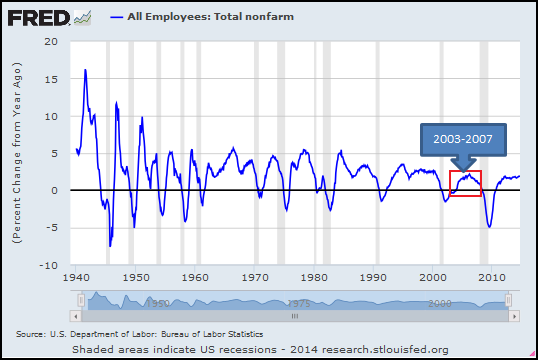
It is certainly fair to say that growth was adequate perhaps even good during the 2003-2007 period. It would not be right to say either that growth was spectacular or that the economy was overheating during this period. And yet this was the time of vast erosion of credit standards, the biggest housing bubble in a century, the emergence of substantial budget deficits and what many criticize as lax monetary and regulatory policies.


"It is certainly fair to say that growth was adequate perhaps even good during the 2003-2007 period."

Good? He's kidding, right?

Graph #1: Percent Change from Year Ago, Industrial Production

Graph #2: Percent Change from Year Ago, Real GDP


Graph #3: Percent Change from Year Ago, Total U.S. Employment


"And yet this was the time of vast erosion of credit standards, the biggest housing bubble in a century, the emergence of substantial budget deficits and what many criticize as lax monetary and regulatory policies."

Well of course. It was very late in a long financial cycle. And just as the graphs show progressive deterioration, finance demands progressively more from the productive economy, until there's nothing left to give.

Thursday, November 6, 2014

"prior to onset of financial crisis"


Lawrence Summers:

Here it is instructive to consider the performance of the US and Eurozone economies prior to onset of financial crisis in 2007.

If you want to know about the crisis, don't spend all your time looking at the crisis. Spend most of your time looking at the sixty years before the crisis.


If you want to know about the crisis, you have to take all the analysis of the past five decades at least and flush it down the toilet. You have to go back, for example, to the analysis that says the mid-1960s inflation was a "guns and butter" problem, throw it away, and be willing to consider a different explanation.

And everything since.

The difficulty lies, not in the new ideas, but in escaping from the old ones, which ramify, for those brought up as most of us have been, into every corner of our minds.

Wednesday, November 5, 2014

The Annual Adjustment


From Brad DeLong, from Larry Summers


Skip DeLong. Read Summers.

Tuesday, November 4, 2014

Locating a Peak


Wikipedia, Decline of the Roman Empire
The causes and mechanisms of the decline of the Roman Empire are a historical theme that was introduced by historian Edward Gibbon in his 1776 book The Decline and Fall of the Roman Empire...

There is no consensus on a date for the start of the Decline. Gibbon started his account in 98. The year 376 is taken as pivotal by many modern historians. In that year there was an unmanageable influx of Goths and other barbarians into the Balkan provinces, and the situation of the Western Empire generally worsened thereafter, with recoveries being incomplete and temporary.

By these accounts, the peak came early (around year 98) or late (around year 376) in the imperial phase of Roman civilization. That's what I once thought, that the Roman Empire was an advance from the Roman Republic -- though really, the Star Wars story could have shown me the error in my thinking.

Arnold Toynbee showed me my error. Wikipedia:
In contrast with the declining empire theories, historians such as Arnold J. Toynbee and James Burke argue that the Roman Empire itself was a rotten system from its inception, and that the entire Imperial era was one of steady decay of institutions founded in Republican times.

The rise of empire was a solution to the problems of the republic.

Monday, November 3, 2014

That's I-E-S, not I-C-S


"Truly great macroeconomists aspire to explain and understand the fundamentals of modern economies." -- Lars P. Syll

Please note: The great ones study economies, not economics

Study the economy.

Sunday, November 2, 2014

"At the start" versus "Since the first moment"


Endogenous Money: The Evolutionary versus Revolutionary Views
Louis-Philippe Rochon and Sergio Rossi

http://www.csbancari.ch/pubblicazioni/rmelab/rossi2.pdf

Page 8 of 17:
Every bank note corresponds as a matter of fact to a double-entry in the books of the issuing bank, a record of which the note is the material representation circulating outside the bank issuing it. As Innes (1913, p. 407) cogently pointed out in this respect, “[a] bank note differs in no essential way from an entry in the deposit register of a bank. Just like such an entry, it is an acknowledgment of the banker’s indebtedness [...]. The only difference between a deposit entry and a bank note is that the one is written in a book and the other is on a loose leaf; the one is an acknowledgment standing in the name of the depositor, the other in the name of ‘the bearer.’” This is a point that Courbis et al. (1991, p. 329) very clearly illustrate referring to British monetary history, particularly at the time of the first goldsmiths in London, around 1660–65. The authors (pp. 324–5) are also clear in noting that book-entry payments existed long before bank notes or their ancestors, say a goldsmith’s certificates, appeared on earth. Indeed, “[t]here is little doubt that money had existed for at least 3000 years before coins were struck, taking a wide variety of forms”(Wray, 2004, p. 235).

Money had existed for at least three thousand years before coins were struck.

I can buy that. Money arose and became part of the culture first, and governments adopted it later. Sure, why not? That's a politician's idea of leadership, right?


Rochon and Rossi, page 3 of 17:
The purpose of this paper is therefore to shed further light on the endogenous nature of money. Contrary to the established post-Keynesian perspective – what we call here the evolutionary view – we argue that money has always been endogenous, irrespective of the historical period. This discussion may be important for both theoretical and policy reasons, a point that we address later in the paper. Overall, however, showing that money has always been endogenous is important in particular for post-Keynesians, since it will help to put the role of central banks and other monetary institutions, as well as financial innovations, in their proper theoretical perspective.

Money has always been endogenous.

Money may have arisen spontaneously, say, some 3000 years before coin. That means money was endogenous at the start. It does not necessarily mean money has been endogenous since the start.

It does not mean that money has always been endogenous.

It's a weak argument to claim that money is always endogenous because it started out endogenous. When governments adopted it, money took on a dual role, endogenous and exogenous. Ever since, private sectors have been struggling with governments over money.

When a government assigns a name to a unit of value -- "the dollar", for example -- they create a standard for the private sector to nibble away at, just as a thousand years ago we were nibbling gold off the edges of coins before passing them along.

When the nibbled coins got generally unacceptable there would be a "recoinage". New, full-bodied coins were issued, and the nibbling would start again. But the government lost gold in the process. Eventually, you would expect to see the government fail.

Today we've taken the gold out of money. Nibbling has taken a different form. But the essential, underlying process is the same: Everybody tries to do better for himself, at the expense of others; and governments ultimately fail. In that process, for better or worse, endogeneity wins out over exogeneity.

That's why, when you look at the world today, you see endogenous money and a failing dollar.


Endogeneity of Money
by Hyman P. Minsky, 1990.

http://digitalcommons.bard.edu/cgi/viewcontent.cgi?article=1429&context=hm_archive

Page 3 of 9:
There are periods in history and economic conditions where the money supply was mainly endogenous and other periods and conditions where the money supply was largely exogenous... Typically the money supply is in part endogenous and in part exogenous.


Saturday, November 1, 2014

Yves is right: Don't dwell on the Monetarism


I see what looks like the whole of Walker Todd's Fed needs to stop asset acquisitions for a generation or so has now appeared at Naked Capitalism, prompting me to respond to it sooner than I had intended. Here's the opening at Naked Capitalism:

Yves here. Readers will take issue with some of former Fed staffer and banking expert Walker Todd’s comments on monetarism and Fed policy, but he nevertheless reaches the right general conclusions.

I don't agree that Walker Todd reaches the right conclusions. I think his analysis is incomplete. His conclusions are premature and must be set aside while the analysis proceeds.


At Free Banking:
The Federal Open Market Committee (FOMC) meeting that ended today (Oct. 29) marked the first chance for the FOMC finally to do the right thing since the onset of the great financial crisis in the late summer of 2008. That right thing consists of resolving not to add even another dollar to the Federal Reserve System's balance sheet for at least the next ten years (and perhaps as long as 30 years) in the absence of officially declared war or national emergency...

In 2007, the year before the crisis, a Fed balance sheet of "only" $929 billion sufficed to promote strong growth in a $14.5 trillion economy (nominal GDP). The Fed's balance sheet was only 6.3 percent of the entire economy. After countless interventions in the economy and a never-ending series of Quantitative Easings (econospeak for money-printing) since then, the Fed's balance sheet is nearly five times larger, but the economy is only 19.3 percent larger. The Fed's balance sheet is now 25.5 percent of GDP.

Finally, if one wished to reduce the Fed's role in the economy to the level that prevailed before the crisis, about 6.5 percent of GDP (the range was 5.9 to 6.9 percent over the preceding eleven years), the current size of the Fed's balance sheet would support economic expansion to nominal GDP of $67.9 trillion, about four times the current size of GDP. Historically, it took 15 years for GDP to quadruple, 1969-1984, and that period included the high-inflation 1970s. In a period of lower inflation, after 1984, it took 28 years for GDP to quadruple again in 2012.

I'm not sure why Walker Todd thinks it might be smart to reduce "the Fed's role in the economy" down to what it was a year before the crisis. It seems to me, without knowing anything, that the Fed's role could have been too small at that time, and this could have been the cause of the ensuing problems.

I'm not claiming that's the case. I'm saying that, not knowing anything, one can still see the obvious connection between the Fed's low level of holdings in the years leading up to the crisis, and the Fed's dramatic increase of those holdings in response to the crisis. Frankly, it looks as if the Fed thought that its small pre-crisis position was part of the problem, and that enlarging its position was most of the solution.

Correlation is not causality, I know. But look: first the low level leading up to the crisis, and then the dramatic increase in response to the crisis. It doesn't necessarily mean that the Fed should maintain a high participation from now on as permanent policy; but it certainly does mean we ought to be pondering the thought. Walker Todd is not pondering it. He just wants to get back to the good old days when we were only months away from severe economic crisis.


The Fed's balance sheet as a share of GDP was 6.3% in 2007, Mr. Todd says, and now it is 25.5% of GDP. I got wondering about that. He doesn't tell me much. So I went looking.

It didn't take long to find something. This is from the Wall Street Journal, in Real Time Economics from March of last year:


Mr. Todd is looking only at the rightmost half-inch of the data shown on this graph. As I said: His analysis is incomplete. For starters, I have two questions. I provide brief answers, but you might want to expand on them for yourself.

Q: When was the economy good?

A: Golden Age, 1947-1973 or so. When the Fed's balance sheet was high as a percent of GDP, high and falling.

Q: When does the Fed's balance sheet increase dramatically as a percent of GDP?

A: During severe crises: economic depressions and world wars.

Maybe the problems in our economy have to do with the Fed's balance sheet being too low. Maybe it's time to ponder this.


Look. Some people worry that the Fed's expanded balance sheet will lead to inflation. The thing that concerns them is that the spending and the money supply may expand in proportion.

If and when that happens, it will happen (as you know) along with expanding debt, because debt creation is the method we use to expand the money supply.

If and when debt expands, we'll being going in the wrong direction again. Yeah, we could get inflation from it, if the expansion is rapid enough. But besides that, we'd get more debt from it. And that's the real problem.

Here's my plan: Keep the Fed's balance sheet big. But reduce the amount of debt that can be piled on top of each dollar of base. That's an easy way to minimize the threat of inflation and an easy way to minimize the potential damage arising from the Fed's expanded balance sheet. Yeah we have to somehow get those reserves out into the economy where they can provide an interest-free alternative to the expansion of credit use. But that's not the big problem.

Okay. Leave the Fed's balance sheet big. Eliminate the threat of inflation by eliminating the possibility of debt expanding to sixty times the Fed's balance sheet. We don't want that ever to happen again.

The Fed's balance sheet is four times as big? Let accumulated debt be only one-quarter as big. One quarter of 60 is 15. So it's okay to let accumulated debt expand to 15 times the Fed's balance sheet, and no more.

Then, assuming we get those reserves out into the economy, we have just as much money in the economy (relative to GDP) as we had before the crisis, so no inflation threat. But we have only one-quarter the debt we had before. Only one-quarter the bills to pay. I don't know about you, but that would free up my spending power.