

Sunday, January 7, 2018

Saturday, January 6, 2018
 Labor Share: There may be more here than meets the eye
At EPI, The decline in labor’s share of corporate income since 2000 means $535 billion less for workers by Josh Bivens.
They show this graph; I added the arrows:

Labor Share goes up and down.
Sometimes, when it goes up, we get a recession. But always, when we get a recession, Labor Share was going up.
So if Labor Share is not going up, I do not expect a recession.
I don't know what's going to happen tomorrow, but I would say Labor Share has NOT been going up lately. No recession in the cards.
// Labor Share as a recession indicator?
See also: When Labor Share Stops Going Down, Employment Growth Stops Going Up
Friday, January 5, 2018
Apparently they really do have economic concerns
Well, I have been selected to represent my state by sharing my opinions on how to protect civil liberties during the Trump Presidency. That's what it says on the big manila envelope that came by mail the other day. DO NOT BEND and Please respond by January 16 and YOU HAVE BEEN SELECTED TO REPRESENT YOUR STATE....
Cost of postage? Ten cents. How do they get away with that?
I want to treat it as junk mail. But it is from the ACLU. I should be honored. Yeah, but how did the bastards get my name? If they were reading my blog, which is about THE ECONOMY, they would know I don't have "opinions on how to protect civil liberties during the Trump Presidency". I guess they don't read my blog.
Okay, I'll open it anyway.
Oh god, a bunch of questions I can't even stand to read!
Here is the last one: To help the ACLU confront those seeking to undermine the Constitution and sweep away our fundamental freedoms, will you send a contribution today?
They want money. How could I not have guessed?
So they do have economic concerns. But they'd rather beg than fix the problem.
Thursday, January 4, 2018
... desire for “wealth” as such, that is, for the potentiality of consuming an unspecified article at an unspecified time.
That definition of wealth comes from J.M. Keynes
Looked up wage suppression. Found this, from EPI:
Wage stagnation for the vast majority was not created by abstract economic trends. Rather, wages were suppressed by policy choices made on behalf of those with the most income, wealth, and power. In the past few decades, the American economy generated lots of income and wealth that would have allowed substantial living standards gains for every family. The same is true looking forward: Overall income and wealth will continue to grow. The key economic policy question is whether we will adopt policies that enable everyone to participate in a shared prosperity, or whether the growth of income and wealth will continue to accrue excessively and disproportionately to the best-off 1 percent.
I want to consider what happens as wealth accumulates.
A two-player game. My income comes from wages. Your income comes from wealth.
At the start we each make 10,000 a year. Say the interest rate is 10%, so your 10,000 income comes from your 100,000 wealth.
Time passes. You do well. Your wealth grows to 1,000,000. Your income is 100,000. My income is still 10,000. You know: wage stagnation.
Time passes again. Your wealth grows to 10,000,000. Your income is 1,000,000. My income is 10,000.
Focus now. Don't ask "How much is enough?" That's not an economic question. Focus.
EPI says:
The key economic policy question is whether we will adopt policies that enable everyone to participate in a shared prosperity, or whether the growth of income and wealth will continue to accrue excessively and disproportionately to the best-off 1 percent.
Right. So let's look at what has to happen to "enable everyone to participate in a shared prosperity".
One way to achieve parity is for my income to keep up with yours. If your income grows from 10,000 to 1,000,000 then my income has to grow from 10,000 to 1,000,000. That's what "shared prosperity" means, I guess. Dunno, really.
One way to get my income to grow like that is inflation. After the inflation, I make 1,000,000. It's only worth 10,000, yeah, but I make 1,000,000.
However, if we have inflation, you will demand a higher rate of interest. My income will fall behind, again. This plan will fail.

Another way to achieve parity is for policy to suppress your income. Maybe policy can do that by reducing interest rates from 10% to 1%. That's not realistic, I know. But this is an economic model. It's not supposed to be realistic (ha ha).
So your income grows from 10,000 to 100,000. Then policymakers see the light and force interest rates down to 1%. Your wealth still grows from 1,000,000 to 10,000,000, but 1% of 10,000,000 is 100,000, so your income stays at 100,000.
My income goes from 10,000 to 10,000 to 10,000. Your income goes from 10,000 to 100,000 to 100,000. Let's say I can live with that.
You can't. You can't live with 1% interest. John Bull can stand many things, but...
So if we want "policies that enable everyone to participate in a shared prosperity", what policies are we going to use? Inflation won't do the trick. Lowering interest rates is unacceptable. What's left?
Maybe we have to put limits on the accumulation of wealth.
Say we cap wealth at 1,000,000 and re-start the game.
In the first period your wealth grows from 100,000 to 1,000,000, and your income grows from 10,000 to 100,000. My income goes from 10,000 to 10,000. So far, everything is the same as when we played this game before.
But now you have reached the wealth cap. Your wealth cannot get any bigger. So your income will not increase any more.
In the second period my income goes from 10,000 to 10,000 and your income goes from 100,000 to 100,000. No increase. But you are still making 10%, so you can be happy about that. Maybe you're not happy about the wealth cap. Life's a bitch.
You're not allowed to accumulate more wealth. If you do, the government will tax it away. Now your face is red and there is smoke coming out your ears. You refuse to let the government tax your wealth away. You'd rather spend it. Harrumph! You'll show them.
So you take all that wealth and income that the government would take in taxes, and you spend it. You piss it away. You party like there's no tomorrow. Good for you. I'm working my ass off while you are partying your ass off. But at least I didn't fall farther behind.
The future has arrived.
By the way... What happens to that nine million of wealth that you are no longer allowed to have? Some other guy accumulates it. Nine other guys. Now you have some competition. The economy is more like a real economy again. Wealth is distributed, not concentrated. And all that extra spending you are doing, well, that just gives those nine other guys a boost! And the rest of us, too.
Wednesday, January 3, 2018
Apparently I'm out of the loop
These days, words seem to change faster even than technology. I was at Forbes trying to read Adam Ozimek amid all the flashy things on the screen. In the sidebar, Star Wars caught my eye:

Star Wars, and the bare arms below it:
How to make your side...
My side?
How to make your side hustle...
Hustle? I was expecting something like How to make your side pain go away...
Does my side hustle? Does my side not hustle enough? Who is on my side? Is this a Conservative/Liberal thing?
All this goes thru my mind before I get to the next word. When I read, I try to assemble the meaning as I go. I don't wait till I get to the end, then gather up the pieces and try to fit them together. I try to make sense of what I'm reading as I go.
Maybe not everybody does that.
How to make your side hustle your main hustle...
Yeah...?
...from a woman who did it.
Oh! A "side hustle" is something you do. Okay. They mean like a business. How to make your side business into your main business. Yeah, that makes sense now.
What a lot of work this is, for nothing.
Did you see me pause there? Pause and say "yeah" and wait, and not try to guess what they were talking about? They forced me to wait to the end, then try to fit the pieces together in order to understand what they said.
It was "side hustle" that did it. It's a new word, new to me. I didn't get the meaning. Maybe if they flagged the term by putting it in quotes it would have been easier to figure the meaning. But hell no! That would ruin the effect. The effect is achieved by going with the flow, new term, new word, new phrase, run with it.
Run with it. Otherwise you're
I can't even guess what the new speak might be, for "out of the loop".
They forced me to wait to the end, by using unfamiliar new terminology. Side hustle. Who knew? They could have put it in quotes. Or they could have made it into one word: sidehustle. Or side-ussle maybe, the way people would say it.
For sure, nobody has time for an "H" these days.
// here's the interesting part
So anyway our new word si'dussle comes from the English hustle. Google lists a few meanings for hustle, including:
1. to "force (someone) to move hurriedly", or
2. to "obtain by forceful action or persuasion."
The latter sense of the term is "North American informal" and includes three branches:
2a. to "coerce or pressure someone into doing or choosing something."
2b. to "sell aggressively."
2c. to "obtain by illicit action; swindle; cheat."
Coerce to action, sell aggressively, swindle and cheat. Given these related meanings, it is interesting to observe that the word "hustle" has come to mean "business".
That reminds me of the archaic meaning of invest: to "surround (a place) in order to besiege or blockade it." That's a good match to the current meaning: to "devote (one's time, effort, or energy) to a particular undertaking with the expectation of a worthwhile result."
Yeah, by "a worthwhile result" they don't mean something like a hobby. They mean something like a takeover.
// on a related note
On a related note, our word business comes from the Old English busyness.
Busyness is to hustle as business is to sidussle.
Google shows similar usage patterns for "business" and "hustle". Increase since the latter 1800s, peak around the Great Depression, reaching bottom around 1970 or 1980, and then increase resumes:
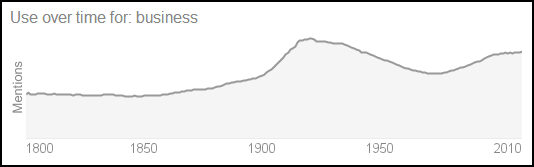

I can't help thinking those patterns bear some relation to this one:

There are lags, of course. "Long and variable" lags.
When I read, I try to assemble the meaning as I go. When I write, I try to make it so you can do the same. I don't want you to have to stop and back up and try to work things out. It's my job as writer to do that part. When you read what I wrote, I want it to go down easy. In the struggle to convey information, that's half the battle.
Tuesday, January 2, 2018
"This goes all the way back to Sumer in the third millennium"
Recommended reading: He died for our debts, not our sins by Claire Connelly:
Michael Hudson says we have been interpreting the bible incorrectly. And he has written an entire book about it. Rather than sex and sin, both Christianity and Judaism are preoccupied with debt. As it turns out, Jesus was a socialist activist who paid the ultimate price fighting for the reinstatement of regular debt jubilees.
Monday, January 1, 2018
The Point of Maximum Gain
Tom Hickey links to Brad DeLong, who quotes Maynard Keynes quoting Malthus:
... there must be some intermediate point, though the resources of political economy may not be able to ascertain it, where, taking into consideration both the power to produce and the will to consume, the encouragement to the increase of wealth is the greatest…
There must be some intermediate point, Malthus says, at which economic growth is best. You know what that is? It's a Laffer Curve for growth. Similar to this:
 |
| Graph #1: via Naked Capitalism |
The benefits and costs depend not only on the size of accumulated debt but also on the relative size of public and private accumulations. Policy, in other words, needs to keep one eye on public debt, one eye on private debt, and a third eye on the ratio of private to public debt. A one-eyed policy that attempts to manage only public debt will never restore health and vigor to our economy.
My estimate suggests that we get the most benefit from an increase in debt when we have about $1.50 of debt for every dollar of GDP. And the best distribution of this debt is to have non-Federal debt between two and three times the size of the Federal debt. So, for one dollar of GDP we want 40 to 50 cents of Federal debt and $1.00 to $1.10 of debt other than Federal. These are ballpark targets for maximizing economic growth.
Sunday, December 31, 2017
The best thing Milton Friedman ever wrote
From the Epilogue of Money Mischief:
... Pierre S. du Pont, a deputy from Nemours to the French National Assembly. Speaking on a proposal to issue additional assignats -- the fiat money of the French Revolution -- he said: "Gentlemen, it is a disagreeable custom to which one is too easily led by the harshness of the discussions, to assume evil intentions. It is necessary to be gracious as to intentions; one should believe them good ...
Saturday, December 30, 2017
Excessive finance
At FiveThirtyEight: The GOP’s Corporate Tax Cut May Not Be As Big As It Looks.
Whatever. But they show this graph:

As you go from left to right along the horizontal axis, the number of firms increases. Also, the dots get bigger: more pixels, more firms, I guess.
Anyway, what's the biggest, rightmost dot? Banks. We have more banks than anything.
Subscribe to:
Posts (Atom)
