Monday, July 12, 2010

Ditto


Back at the beginning of '09, Paul Krugman was iterating about a Dark Age in economic thought. He happened to quote, among other things, this from John Cochrane:

Second, investment is “spending” every bit as much as consumption. Fiscal stimulus advocates want money spent on consumption, not saved. They evaluate past stimulus programs by whether people who got stimulus money spent it on consumption goods rather save it. But the economy overall does not care if you buy a car, or if you lend money to a company that buys a forklift.

I think a word or two got lost in translation. But that is one precious paragraph. PK let it slip away. Here are my notes:

1. Investment is “spending” every bit as much as consumption.

Yes, yes, yes. When somebody buys industrial equipment or puts up a factory building, that's investment. More precisely, it is investment spending. When I stick a dollar in my savings account, that's not investment. It's investment when Dean Kamen takes a loan and spends the money to build another nifty invention. It's investment when money gets spent like that.

2. Fiscal stimulus advocates want money spent on consumption, not saved. They evaluate past stimulus programs by whether people who got stimulus money spent it on consumption goods rather save it.

This is a whole other can of worms. I don't like too much to talk about what other people want. So I won't talk about what Cochrane says other people want. But Big-C distinguishes clearly between spending and saving. That's important.

3. The economy overall does not care if you buy a car, or if you lend money to a company that buys a forklift.

Excellent: The economy does not care what we want. We care. Actually, I'm surprised Cochrane says that to the economy, consumption spending (buying a car) is no different than investment spending (buying a forklift). But then I guess the economy doesn't care if it grows, or not.

Inadequate growth is not a problem for the economy. For the economy, it is a solution to Problem X. If we think inadequate growth is a problem, our task is to identify Problem X.

Ditto inflation. Ditto unemployment. Ditto ditto ditto.

Sunday, July 11, 2010

Words with Linda


If you go here and click on the "Regular Job" video, about 24 seconds into her 61-second commercial Linda McMahon says

We're losing jobs because Washington politicians are
spending money we don't have.

Money we don't have. That's exactly what I've been saying, Linda. The Federal Reserve restricted the growth of money in order to fight inflation. But they restricted it too much. And that, Linda, is why we don't have money.

Nobody believes that, because of the inflation. Everybody thinks there must be too much money, because of the inflation. But nobody has money, Linda. Taxpayers and governments struggle over tax dollars; and business is not good.

Taxpayers know taxes are too high. Governments know revenues are insufficient. Businesses know income and profits are too low. No sector of the economy has the money, Linda. All sectors of the economy agree, or could agree that money has been excessively restricted by the Federal Reserve. But instead, we fight over taxes and spending.

You're right, Linda: Nobody has money. We all use credit. We all have debt. Nobody has money.

Little Sammy Has Two Santa Clauses


I don't usually just quote large chunks of other people's stuff, and I almost always have some comment about the quoted material. But the excerpt below, from the Wikipedia article Jude Wanniski, I found so interesting that I just want to present it:

The Two Santa Claus Theory

The Two Santa Claus Theory is a political theory and strategy developed by Jude Wanniski in 1976, which he promoted within the U.S. Republican Party.

The theory states that, in democratic elections, if one party appeals to voters by proposing more spending, then a competing party cannot gain broader appeal by proposing less spending. The "Santa Claus" of the theory title refers to the political party that promises spending. Instead, "Two Santa Claus Theory" recommends that the competing party must assume the role of a second Santa Claus by offering other appealing options.

This theory is a response to the belief of monetarists, and especially Milton Friedman, that the government must be starved of revenue in order to control the growth of spending (since, in the view of the monetarists, spending cannot be reduced by elected bodies as the political pressure to spend is too great).

The "Two Santa Claus Theory" does not argue against this belief, but holds that such arguments cannot be espoused in an effort to win democratic elections. In Wanniski's view, the Laffer curve and supply-side economics provide an attractive alternative rationale for revenue reduction: that the economy will grow, not merely that the government will be starved of revenue. Wanniski argued that Republicans must become the tax-cutting Santa Claus to the Democrats' spending Santa Claus.

Saturday, July 10, 2010

Two from My Budget 360


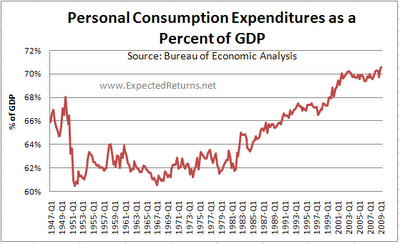
I want to point out that this graph, from the post American middle class slowly disappearing under mounds of debt...

I want to point out that if you follow along the 62% line, it looks like Personal Consumption Expenditures are stable at that level from around 1950 until 1979 or 1981 or so. And that the dramatic rise probably starts then, not around 1967 as it may appear at first. And the increase is steep when you see it starting around 1980, much steeper than it appears if you think the increase started back in '67.

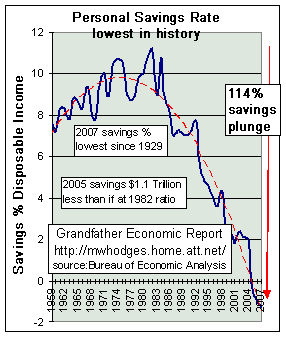
And I want to point out that this graph -- Grandfather Hodges' graph, also from the My Budget 360 post -- shows pretty much the same turning point, around 1979 or 1981. The dotted red line on the graph (not my red line, this time!) has the peak a little earlier, mid-1970s or so. But that's too early, I think.

To see this trend-line work backwards. Start on the right, with the newest numbers, and picture a straight line up to the high point right around 1983. That's the kink. From there, go left to the early years of the graph with another straight line that goes down below the "8" there.

Both graphs show a turning point around 1980.

Just two more graphs that display the Keynes/ Reagan Shift.

Oh, That's a Laugh


Looking into median family income while reviewing some Krugman posts, I find this in Wikipedia [7-2-2010] under "Household income in the United States" --

In 2007, the "real" (adjusted for inflation) median annual household income rose 1.3% to $50,233.00 according to the Census Bureau.

When you figure "real" values, they are always based on a base year: Real values are always given relative to some starting point. If you change the base year, you change the numbers that are reported as "real." So the $50,233.00 number is meaningless.

Assuming some minimal inflation, you can make "real" values sound higher by moving the base year closer to the present. You can make "real" values sound lower by moving the base year farther into the past.

It is perfectly fine to say "income rose 1.3%" from the previous year, or from some previous date. But it is utterly meaningless for Wikipedia to put a dollar amount there. The article fails to identify the base year.

Friday, July 9, 2010

Being Paul Krugman


Krugman of July 8, 2010:

the sensible thing [would be to] run deficits while the economy is depressed, then turn to budget-balancing once recovery is well in place

So, Krugman says: Don't worry about balancing the budget, we can balance the budget later. That's what he says on the 8th.


Krugman of 9 July 2010:

And by the winter of 2008-2009, it was obvious that this was the Big One — which, if the aftermath of previous major crises was any guide, would be followed by multiple years of high unemployment.

On the 9th, it is obvious to Krugman that we're not going to have the kind of recovery that will bring the budget into balance.


Krugman does not have the answer.

Sit Down Quickly


Here is logic that I dispute:

  • Fact: Taxes are too high.
  • Fact: Government collects all that tax revenue, and still has huge deficits.
  • Conclusion: Government spending must be excessive.

I don't dispute the facts, just the conclusion. The conclusion is based on the view that excessive spending creates debt. But debt is not created by spending. Debt is created by the use of credit.

The Prodigal Son went out and spent his whole inheritance, and returned home to Daddy, broke. That was excessive spending.

Nothing in that story says he returned home in debt. The Prodigal Son is an example of excessive spending, apart from debt and deficit and the use of credit.

Oh I just noticed this: The very next story after the Prodigal Son is about the Steward who cut the debts that people owed to his boss. Now that is a story about the use of credit. And, notably, the boss was happy with the steward's work. (Perhaps because business picked up as a result.) Take thy bill, and sit down quickly, and write fifty. That's the solution to our problems, right there: Cut the debt, quickly. But I wander.

The Prodigal Son is a story about excessive spending, where the use of credit is not involved. On the other hand, the person who can barely make ends meet, the person who doesn't have the money to pay for gasoline but must put it on a credit-card in order to get to work -- this is a story about the use of credit, where excessive spending is not involved.

Excessive spending is one thing; the use of credit is another. Sometimes, perhaps often, the two are combined in a single act. But that is not always the case.

The whole world thinks we have to balance the budget, and we have to cut spending to do it, and spending is excessive. Even the people who make up the "special interests" think that way. But not me.

I think economic policy removed money from circulation, and encouraged the use of credit in its place. The result was that we learned to use credit for money. And the consequence of that was debt. Grotesque levels of debt.

It is our policy to fight inflation by removing money from circulation. It is our policy to stimulate growth by encouraging spending and the use of credit. And it is not our policy to encourage the repayment of debt. Policy -- not excessive spending -- is the source of our economic troubles.

It is time for policymakers to sit down quickly.

Thursday, July 8, 2010

Just Pay It Off

Krugman again. He writes:

OK, there are signs that the Fed is nerving itself up to do something more to support the economy. The question is, how much are the kinds of actions likely to be on the table likely to matter?

Here's what he looks at:

  • Will the Fed buy long-term government debt?
  • Will the Fed buy private debt?
  • Will the Fed commit to a higher inflation target?

PK thinks the higher inflation target is the best option, if least likely. I don't even want to talk about that option. I want to talk about the Fed buying debt.

Krugman thinks the Fed can reduce long-term interest rates -- that's PK's goal -- by buying up debt. But he doesn't think it would have a "strong" effect. And he thinks it would take trillions of dollars of buying; probably closer to ten trillion than two.

Yikes.

Krugman wants to jack up inflation. This is Scott Sumner's idea, and Sumner says it well. But Krugman doesn't say why he wants to send inflation higher. So I'm gonna guess at that.

Inflation devalues debt; it makes existing debt smaller. If by inflation you double your income in the next three years, your mortgage payment will be a lot easier to bear. I think that's Krugman's goal, or part of it: to make the debt bearable.

PK, PK, I'm shakin' my head here. If you want your plan to be popular, number one, don't be calling for more inflation. I know, I bought my old house back in 1977 and with the inflation that soon followed, in a few years my monthly mortgage payment seemed like a joke. I know. But it doesn't matter. People don't want another bout of severe inflation, Paul. I don't. It doesn't matter if it would help us. It's not a solution, Paul. It's not a solution. Inflation is not a solution.

The problem is debt, Paul. You know: The Fed might buy up some of that debt, you were saying...

Paul, what are you thinking? If the Fed buys up tons and tons of debt, eventually lenders will be in good shape again. And then they'll be ready to lend again. And they'll be willing to lend us even more money, and create even more debt. Paul, what are you thinking?

Paul, Paul, Paul: It is time to stop thinking only in terms of lenders. It is time to start thinking in terms of borrowers.

Paul, the problem is debt. I don't care who owns it. I care who owes it. If the Fed buys up all the debt, every last bit, nothing has changed for me. Nothing has changed for anybody. Only for the lenders. And then they'll be ready to lend more. To hell with that, Paul! What were you thinking?

Okay, if the Federal Reserve was gonna buy debt, they would print money and use that money to buy the stuff. And then they would have the debt, and the lenders would have the new money.

What does that do for me?

Here's what I want you to do, Paul. Stop thinking only about the lenders. Start thinking also about the borrowers. Supply and demand, remember Paul? Supply and demand. Lenders and borrowers.

Here's what I want the Fed to do, Paul. I don't want them to buy debt. I want them to make debt go away. I want them to take their trillions that they're gonna use to buy debt. And I want them to use that money to pay off debt. Pay it off. Just pay it off. Make the debt go away. That's what I want.

And I'll tell you Paul, that's the only thing that will end this problem. The only thing.

Gold Backing and the Fractional Reserve


In a recent post, Sackerson writes:

There is something like 100 ounces of gold "on paper" for every ounce of gold you can hold in your hand. I now often see online comments recommending the possession of physical gold because of concerns over delivery on all those paper promises.

A hundred ounces of gold on paper for every ounce you can hold in your hand. It sounds almost like fractional-reserve banking.